


A Foundation That Begins in a Mine: How moto Turns Tōei’s Sericite Into Light on the Skin
- May 8
- 9 min read

Some base makeup does not begin under department-store lights.
It may begin in the mountains. In a seam of ore. In a white powder that has been mined, screened and refined again and again. In the moment it is picked up by a fingertip and smoothed across the skin — fine, soft, almost slippery, with a quiet trace of light.
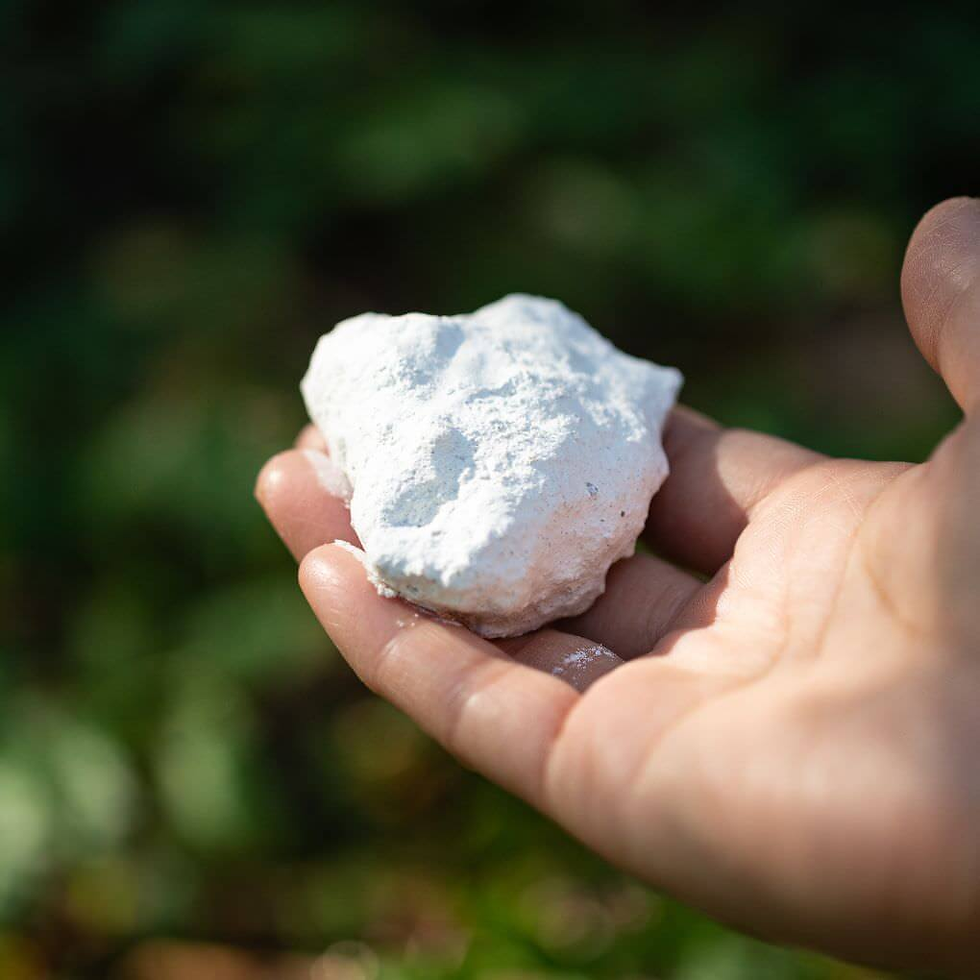
The Japanese natural mineral makeup brand moto was born in Tōei, a small mountain town in northeastern Aichi Prefecture. The town has a population of roughly 2,600 and faces the same pressures as many rural communities in Japan: fewer children, an aging population and young people leaving for larger cities. It also has something rare: cosmetic-grade セリサイト — sericite, or silk mica.
Sericite sounds like a mineralogist’s word, but it is closer to daily life than it seems. The fine texture and muted sheen of foundation, face powder and eye shadow often come from mineral powders like this. Tōei’s sericite is prized for its fineness, smoothness and silk-like luster, and has been used in cosmetics in Japan and abroad.
What moto set out to do was bring this material — usually hidden at the back of an ingredient list — back to the place it came from.

“moto”: Makeup That Begins With 素
The name moto comes from the Japanese word 素 — pronounced moto.
素 means the unadorned state of something. It can also mean origin, foundation, or what lies at the root. For the brand, the word is not a clean-sounding slogan. It points to a more practical set of questions: Where does something that touches the skin every day come from? Who makes it? Can it have a more honest relationship with the land, the environment and the person using it?
The brand has described its thinking this way:
「物事の本質や成り立ちに意識を向けて、人と環境に正直なモノづくり」
In English: making things with attention to their essence and origins, in a way that is honest to people and the environment.
Left as an idea, that sentence could become abstract. What makes moto interesting is that it really does begin with a mine, a shrinking rural town and one woman who had to be unusually careful about what she put on her skin.

Chihiro Ooka: From Festivals and Rural Revitalization to Foundation
moto was founded by Chihiro Ooka.
Born in 1991 in Wakayama City, Ooka was not, by her own account, an especially strong student. She later entered Kyoto University of Art and Design — now Kyoto University of the Arts — where she studied three-dimensional modeling and sculpture. In her first year, she wanted to join an art project connected to society, but missed the interview. By chance, she joined a program in Shimane Prefecture to study the traditional performing art 石見神楽, Iwami Kagura.
For the next four years, she traveled frequently to Shimane and took part in kagura performances. She also saw, up close, how rural towns were slowly emptying out. Young people left. Shops closed. Festivals were still lively, but the number of people able to support them was shrinking.
Before graduating, she took night buses, rented bicycles and visited about 60 festivals across Japan, looking for a place where she might commit herself. In December of her senior year, she arrived in Tōei to see 花祭, Hanamatsuri, often described as one of Japan’s three great kagura traditions.
What kept her there was not only the festival. Local residents saw a young woman from elsewhere arriving alone with a large backpack. They invited her inside, gave her oden and let her rest at the kotatsu. That direct, unforced warmth became one reason she later moved to Tōei.
In 2013, at 22, Ooka moved to Tōei as an Iターン — someone relocating to a rural area outside their hometown — and joined the 地域おこし協力隊, Japan’s rural revitalization cooperation program.
Her first assignment was to help revitalize the area through 山菜, edible wild mountain plants. She cleared land and planted with local residents, only to realize later that mountain vegetables can take about three years from planting to harvest. The cooperation program also lasts three years. In other words, she might complete her entire term before seeing results.
For a time, she was lost. She had just left university, had little work experience and did not yet know what she could offer the town.
The turn came through a concrete proposal. The president of Sanshin Mining Industrial Co., Ltd., the company that mines Tōei’s high-quality sericite, approached her with an idea: to turn this rare mineral resource into a way for more people to come to know the town.
For Ooka, the idea met a personal problem. She had sensitive skin — in Japanese, she describes herself as 肌弱なタイプ — and many commercial cosmetics caused irritation. Buying base makeup felt like taking a gamble. When she learned that Tōei’s natural mineral could be used to make foundation with a visible material source, she said yes.
A mineral from the mountains of Tōei had found its way into her own experience of skin.

naori: Entering the Mine, Making Foundation by Hand
Before moto, Tōei already had an unusual experience program: naori なおり®.
naori goes further than a typical hands-on workshop. Participants enter the mountain mine, learn where cosmetic raw materials come from, and then use sericite mined in Tōei to make their own foundation.
The name naori comes from the mining term 直り. In a vein, it refers to a place of especially high grade, often formed where veins intersect or where the angle of a vein changes.
The term carries another meaning here. People come to Tōei and meet the mine, the powder, the skin and local residents. A box of foundation is no longer just one step before makeup. It becomes a route back to source.
Later, this registered ビューティーツーリズム® — Beauty Tourism — drew visitors to Tōei and helped people see the mountain town from another angle: as a place connected to beauty at its origin.

The Pandemic Stopped the Experience. It Also Led to moto.
After 2020, the pandemic forced naori to suspend its programs or limit the number of participants. What had once depended on people coming in person — entering the mine, making foundation by hand, feeling the material for themselves — could no longer be brought to them in the same way.
Ooka and her team began to ask a different question: If people could not come for a while, could the product go out first?
That question became the starting point for moto cosmetics.
In 2021, Ooka established 株式会社もと, Moto Inc., and began developing makeup products that would make Tōei sericite usable in everyday life. Development was not simple. In ordinary cosmetics, mineral powder is often only one part of a formula. moto wanted to raise the proportion of Tōei sericite substantially, so that the material itself would become the center of the base makeup.
The foundation contains more than 60 percent sericite. The powder contains more than 80 percent. Getting that amount of mineral powder to blend evenly while still feeling smooth, gentle and not drying on the skin was not a matter of simply adding more raw material.
After two and a half years of repeated trials, the team released もと ミネラルリッチファンデーション — moto Mineral Rich Foundation — and もと ミネラルリッチパウダー — moto Mineral Rich Powder.
Behind a single box of foundation are a mine, a rural revitalization project and the persistence of someone with sensitive skin who wanted something she could use with confidence.
Why Tōei Sericite?
Sericite is a natural mineral and one of the powder bases commonly used in base makeup. It gives makeup a fine texture and soft sheen, and helps it sit more naturally on the skin.
According to the brand’s materials, Tōei in Aichi Prefecture is the only place in Japan that produces cosmetic-grade sericite. The sericite mined and refined there by Sanshin Mining Industrial Co., Ltd. is stable in quality and is used not only in Japan but also in cosmetics around the world.
moto’s difference lies in not treating sericite as just another ingredient. It places the material’s origin, proportion and feel at the center of the product.
The finish created by a high proportion of sericite is not heavy coverage. Nor is it an obvious pearl effect. It is closer to a soft matte translucence with a fine, quiet luminosity. As the powder moves across the skin, it has a texture close to silk. It softens the look of pores and uneven tone while leaving the skin’s own texture visible.
That is also why moto asks to be used slowly. It is not trying to make the face into another face. It makes the skin already there look calmer, cleaner and more settled.

Another Detail in the Formula: Tea Seed Oil
In addition to sericite, moto uses 茶油, tea seed oil, pressed from the fruit of tea plants.
The tea seed oil is not there to add fragrance. It is not there to make the ingredient list look fuller. Its role is closer to that of a mild skin-care oil: helping the powder adhere to the skin, while adding a small measure of moisture during application.
For base makeup, this is the kind of detail that is easy to miss until the product is used. Powder cannot only be fine; it has to stay with the skin. Makeup cannot only look good; the skin has to be able to live in it.

To Feel Sericite in Person, Visit もとの店 in Tōei
For travelers to Japan looking for a quieter destination with a stronger sense of place, Tōei belongs on the list.
moto’s directly operated shop, もとの店, opened in Tōei on December 12, 2025. The shop is located at:
42-1 Hirai, Shimoda, Tōei, Kitashitara District, Aichi Prefecture, inside datte
Japanese address: 愛知県北設楽郡東栄町下田字平井42-1(datte内)
The shop is not only a place to buy moto products. It also carries local specialties from Tōei and works by ceramic artists who live in the town. For someone encountering moto for the first time, the best beginning may not be choosing a shade right away. It may be touching the sericite powder with a fingertip and understanding why people describe it as silk-like.
Because the shop operates on an irregular schedule, visitors should check the official Instagram account, @MOTO_SELECT, before going.
Outside the directly operated shop, moto products are also available at selected retailers, including @cosme NAGOYA at Nagoya Station in Aichi Prefecture, 豊穣屋 in Toyokawa and A.U.S東京 in Tokyo.

Back to the Source of a Single Foundation
What makes moto compelling is not that it loudly claims to be “natural.” Nor is it that it packages a rural story too neatly.
It reminds us that the powder brushed onto the face each day was once part of a mountain.
Tōei’s mineral veins, Sanshin Mining’s extraction and refinement, naori’s mine experience and Ooka’s own understanding of sensitive skin all end up, finally, in a box of foundation, a jar of powder and a makeup brush.
In the morning, the powder settles onto the skin. That small light comes from the mountains of Aichi.


Comments