


When Craft Starts Talking About Vision: After Jun Nakagawa’s Appointment, Where Does the Good Design Award Want to Take Design? | TOKOWAKA
- Apr 17
- 9 min read
Updated: May 2

From the preservation of technique and the renewal of production regions to the language of management, the questions the Good Design Award has been asking in recent years are changing the way craft itself is understood.
In 2026, Jun Nakagawa became chair of the Good Design Award jury in Japan. The appointment drew attention for more than one reason. Nakagawa has spent years working at the intersection of craft branding and regional industry renewal, but what he also brings to design evaluation is a sharper question: Does a work truly carry the vision of the company or organization behind it? Once craft is placed under that kind of scrutiny, the conversation begins to shift. Evaluation no longer stops at technical preservation or the finish of a single object. It stretches outward, toward management, education, local systems, and long-term direction.
When people think of design awards, many still picture products with strong visual character, high polish, and an obvious air of “good design.” But the Good Design Award has, in fact, been moving along a wider track for some time. In 2027, the Japanese design prize will mark its 70th anniversary. At this point in its history, its concern is no longer simply whether a product is well made or visually resolved, but how design enters everyday life, industrial systems, and social conditions.
That is why Nakagawa’s appointment in 2026 is worth watching. It is more than a change in personnel. It feels more like a signal from the Good Design Award itself: design will now be questioned more deeply, and craft will be seen more fully.
Why this leadership change feels unusually telling
Jun Nakagawa has spent years leading Nakagawa Masashichi Shoten while remaining deeply involved in the practical work of craft branding, regional industries, and the renewal of production areas in Japan. Unlike critics or industry observers who approach design from a distance, he has stood on both sides at once: the side of management and the side of making. He knows how a technique is preserved, but he also knows that preservation quickly loses its footing if there is no market, no organization, and no next generation willing to carry it forward.
So when he moved into the core of the Good Design Award’s judging structure, attention did not center only on his aesthetic judgment. The larger question was what kind of questions he would bring with him.
The answer is clear enough: vision.
The Good Design Award is no longer asking only whether a work is good
According to official materials, one of the key ideas Nakagawa has put forward is “design that contributes to vision”—in Japanese, bijon ni shisuru dezain. The point is not simply whether a design is competent, appealing, or complete, but whether it actually advances the vision of the company or organization behind it.
What gives that phrase its force is that it adds another, more grounded layer to design evaluation. A work can no longer be judged only by form, function, or execution. It also has to answer a different question: Is it genuinely moving in the same direction as the brand, company, or institution presenting it?
Nakagawa has used a public example to make the point. A laundry basket made by MARNA may be a mature and accomplished design in its own right. But if the same object—made of the same materials, with the same choices—were to come from Nakagawa Masashichi Shoten, it might sit awkwardly against the brand’s larger trajectory. That example has been discussed not because it ranks one material above another, but because it reveals something more basic: design cannot be severed from the ideas that are meant to guide it.
That framing matters especially in craft. Many craft industries are not short on good objects. What they lack is direction. The techniques are there. The work can still be made. But the harder question—where all of this is meant to go next—often remains unarticulated. Over time, craft then slips into an uneasy position: clearly worth preserving, yet difficult to move forward.
What he seems intent on repairing is the split between management and making
Another phrase Nakagawa returns to often is “a common language.”
His argument is that many companies and design teams today are not failing because they refuse to work together, but because they are not actually speaking from a shared vocabulary. Executives talk about brand, mission, and direction. Designers talk about form, expression, and user experience. Both may think they are discussing design, while often meaning different things entirely.
That gap becomes even more pronounced in craft.
Because craft has never been only about product development. It also involves broken chains of process, access to materials, aging production regions, succession, retail channels, pricing structures, and education. Designers alone cannot solve those problems. And if management does not understand design, it becomes difficult to open the next path at all. What Nakagawa calls a “common language” is, in practice, an attempt to build a shared basis from which both sides can work.
That is also why his appointment has been read as a symbolic turn. What the Good Design Award may begin to value more explicitly is not just the object itself, but whether the object is supported by a coherent method, a persuasive narrative, and a long-term plan.
In craft design today, the hardest problems are often not in the object itself
Seen through the Good Design Award’s recent judging framework, this shift is not entirely new. The award has not been looking only at objects for some time. Its official criteria continue to emphasize four broad dimensions—human, industry, society, and time—which means design is being read within a larger frame: Who is it for? Under what industrial conditions does it exist? What social problems does it address? Can it endure?
In craft, that perspective is especially important.
Because the most difficult problems are almost never visible on the surface of the work. Is the clay still available? Can the kiln still be fired? Who is making the molds? Is there still someone to carry the process from one step to the next? Are younger people entering the field? Is the way of learning still too closed to sustain itself? These are not always the most visible questions, but they determine whether a craft can continue to exist at all.
So when we talk about craft design today, we are not only talking about whether the object is good enough. We are also talking about whether the ecosystem around it can still live.
A few examples show how the Good Design Award has been reading craft
If you look across past Good Design Award winners related to craft, a pattern begins to emerge. The most representative projects are usually not the ones that make tradition look most traditional. The ones that remain memorable are the projects that found a new place for older techniques.
“1616 / arita japan” (2019)
Winner of the Good Design Award in 2019. The significance of this project lies in the way it freed Arita ware from dependence on a single kiln or on a fixed image of place. Through collaboration with outside designers, the technique was brought into new contexts of use and into an international design language. What changed was not only the appearance of the vessels, but the way the production region itself could be understood.

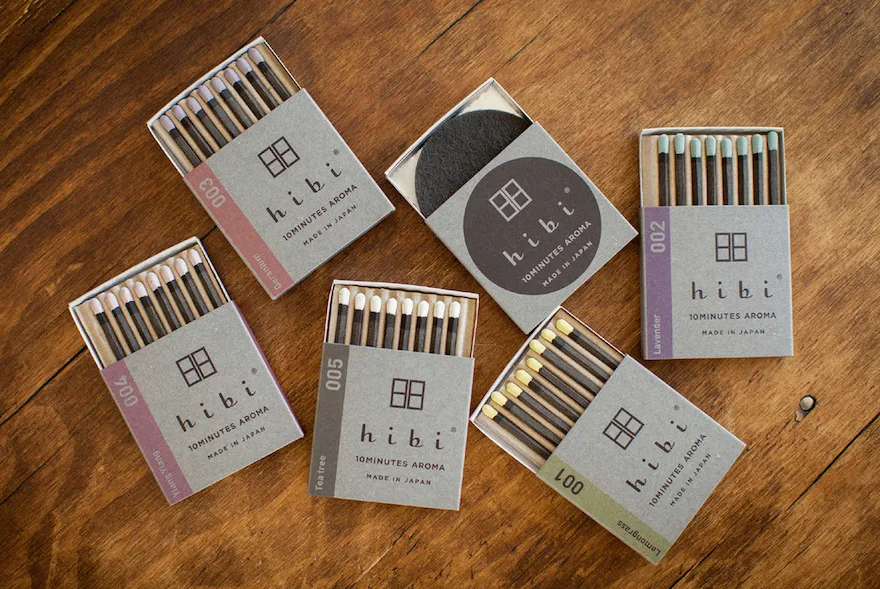
“hibi 10 MINUTES AROMA” (2019)
Also a Good Design Award winner in 2019. This project brought together two industries in gradual decline—matches and incense—and gave them a new point of contact. What made it stand out was not simply the novelty of the idea, but the precision with which it responded to a small, real desire in contemporary life: the wish to carve out a brief pause that can be lit, sensed, and inhabited.
Taken together, these projects suggest that what the Good Design Award cares about is not whether something feels “craft-like,” but whether a technique has genuinely re-entered the present.
“SUWADA Nail Nipper Universal’” (2023)
This product comes out of the forging tradition of Sanjo, Niigata. It first received a Good Design Award in 2016, and a related product was later selected for the GOOD DESIGN BEST100 in 2023. What makes the case important is the way it brings a forging technology more closely associated with industrial tools into the realm of personal care, while also establishing a relationship of repair and long-term use. Here, craft is not simply about precision, nor merely about luxury. It is about staying useful over time.

“seiseisha uzra series” (2025)
This series, by 224porcelain, won the Good Design Award in 2025 and also received the GOOD FOCUS AWARD [DESIGN OF TECHNIQUE & TRADITION]. According to official materials, the series uses a new material called Seido, which can be fired without glaze and still retain a direct, matte surface texture.
What matters here is not only that the objects succeed formally in their quiet, restrained appearance. The project also pushes the discussion of craft further back into process itself: how materials are revised, how firing is adjusted, how resources are used more effectively. The details least visible at first glance become the true center of the work. In the context of the Good Design Award, what 224porcelain seems to have been recognized for is precisely this ability to reconnect traditional technique, material renewal, and contemporary production conditions.

Taiwan’s recent momentum is moving in the same direction
If we shift the focus back to Taiwan, Taiwan’s visibility at the Good Design Award has clearly grown in recent years. And what has been recognized is no longer limited to hardware products. The scope has expanded toward public design, educational methods, regional action, and the renewal of craft.
One particularly telling example is the Taiwan Yuan-Li Handiwork Association’s “Next Artisan, a new way to preserve traditional rush weaving art” (2025).
The project was selected for both the GOOD DESIGN BEST100 and the GOOD FOCUS AWARD [NEW BUSINESS DESIGN] in 2025. What makes it important is not that it offered a compelling presentation of rush weaving, but that it addressed a more basic problem: how a technique can be broken down, turned into modular learning, and supported by systems of certification and transmission, so that a craft once heavily dependent on oral teaching and individual experience becomes a path people can actually enter again.
Projects like this align closely with what Nakagawa means by vision. The most forceful forms of craft renewal are rarely sustained by a single star product. More often, they come from reorganizing learning, labor, place, and the future all at once.


What may change next is not the answer, but the question
It is still too early to say whether the Good Design Award will shift dramatically under Nakagawa. But from what has been made public so far, one thing is already clear: design is now being asked to answer for more than form and innovation. It is being asked whether its ideas are concrete, whether the organization behind it knows where it is headed, and whether the work itself can carry that direction into reality.
For craft, that is an important line of questioning.
Because what threatens craft most is often not being forgotten, but being preserved so carefully that it loses its function. The story is well told. The technique is respected. But no new people enter the field, no new structure of work emerges, no new relationship of use takes shape. At that point, preservation risks ending as display.
The perspective Nakagawa brings makes the issue more direct. If craft is to continue, it has to deal at once with technique, management, education, brand, place, and the next generation. Remove any one of those, and vision collapses easily into slogan.
If craft is to remain, it has to return to the ground
At this point, the Good Design Award’s way of looking at craft has become increasingly clear. It looks at technique, but also at the organizational capacity behind it. It looks at the work, but also at whether that work can slowly build up a place, a company, and a set of values.
This kind of evaluation is harder than before, but also more grounded.
Because the question it finally has to answer is not only whether craft can be preserved, but in what form it will continue to live.
Sources:


Comments